 POR
POR
 ENG
ENG


The best dental insurance for dental implants
Finding insurance with coverage for dental implants is of utmost importance to ensure better value for money. Know the covers of the best dental insurance for implants.

The 7 most common oral diseases
Learn about the 7 most common oral diseases that affect millions of people around the world every year. Pay special attention to #7!

How tobacco affects the health of your mouth
Smoking not only affects your whole body, it also greatly damages the health and aesthetics of your mouth. Stained teeth, bad breath, implant failure, cancer and poor healing are some of the most common diseases it can cause.

Oral Health: daily care
To maintain proper oral health, it is necessary to carry out a series of practices on a daily and methodical basis. Let's see what this condition is about and how it is done effectively.

Pulp Necrosis: Severe dental pain that disappears
by Wildsmile
Have you ever had a severe toothache that lasts for 2 or 3 days and then magically disappears? Be very careful, it could be a warning sign that something worse is coming. In this article we will tell you about pulp necrosis and how to treat it.
Pulp Necrosis
Pulp necrosis means that the pulp of the tooth has died because of an acute infection, usually caused by an untreated dental decay. When caries perforates the tooth, it attacks the dental pulp to the point of killing it, hence the intense pain that lasts for a few days! The pain disappears because the tooth is left without nerve endings. There are two types of pulp necrosis, depending on the affected area:
- Total. This is when the entire pulp dies.
- Partial. When only a part of the pulp dies.
You may be interested in reading: DENTAL CARIES, YOU BETTER DETECT IT ON TIME!
What is dental pulp?
The dental pulp is the soft tissue found inside each tooth that contains the nerve, blood vessels and connective tissue. The main function of the dental pulp is to provide nutrients to the tooth, which is why its loss is so serious and delicate.
How pulp necrosis is treated
Unfortunately, there are not many options for this condition. The treatments to treat a necrotic tooth are endodontics or tooth extraction. When the severity of the necrosis is considerable and saving the tooth is impossible, extraction will be required. In the case of a root canal or endodontic treatment, it is performed when the necrosis is partial and only the dead pulp tissue will be removed from the tooth.
Consequences of not treating pulp necrosis
As it is an intense pain that disappears after a few days, most people ignore it and do not consult a specialist, leading over time some complications such as:
- Abscesses
- Sinusitis
- Periodontitis
- Bone loss
- Loss of teeth
- Infections
It is very important to remember that you should not neglect the pain signals that your body sends you, as taking care of them can prevent us from several diseases. Take care of yourself and your teeth.
You may be interested in reading: DO YOU KNOW HOW YOUR DENTIST WILL TREAT YOUR DENTAL CARIES?
Want to learn more about this?
Contact us
Your contact request is registered. We will contact you as soon as possible.

Teeth Whitening: myths
Teeth whitening is a process that is at the top of its existence. Having white teeth has become one of the aesthetic priorities of many of us. This has led to the emergence of myths about it.
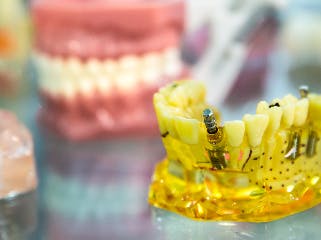
Removable Dental Prosthesis: definition, manufacture and hygiene
The removable prosthesis is a dental restoration treatment that allows it to be removed from the mouth at will. Its purpose is to replace one or more dental pieces that have had to be removed.

Oral Health: daily care
To maintain proper oral health, it is necessary to carry out a series of practices on a daily and methodical basis. Let's see what this condition is about and how it is done effectively.
Lorem ipsum dolor sit amet, consectetur adipisicing elit. Adipisci alias aliquid amet commodi dolor, dolore doloremque dolores fugit quod repellat.